
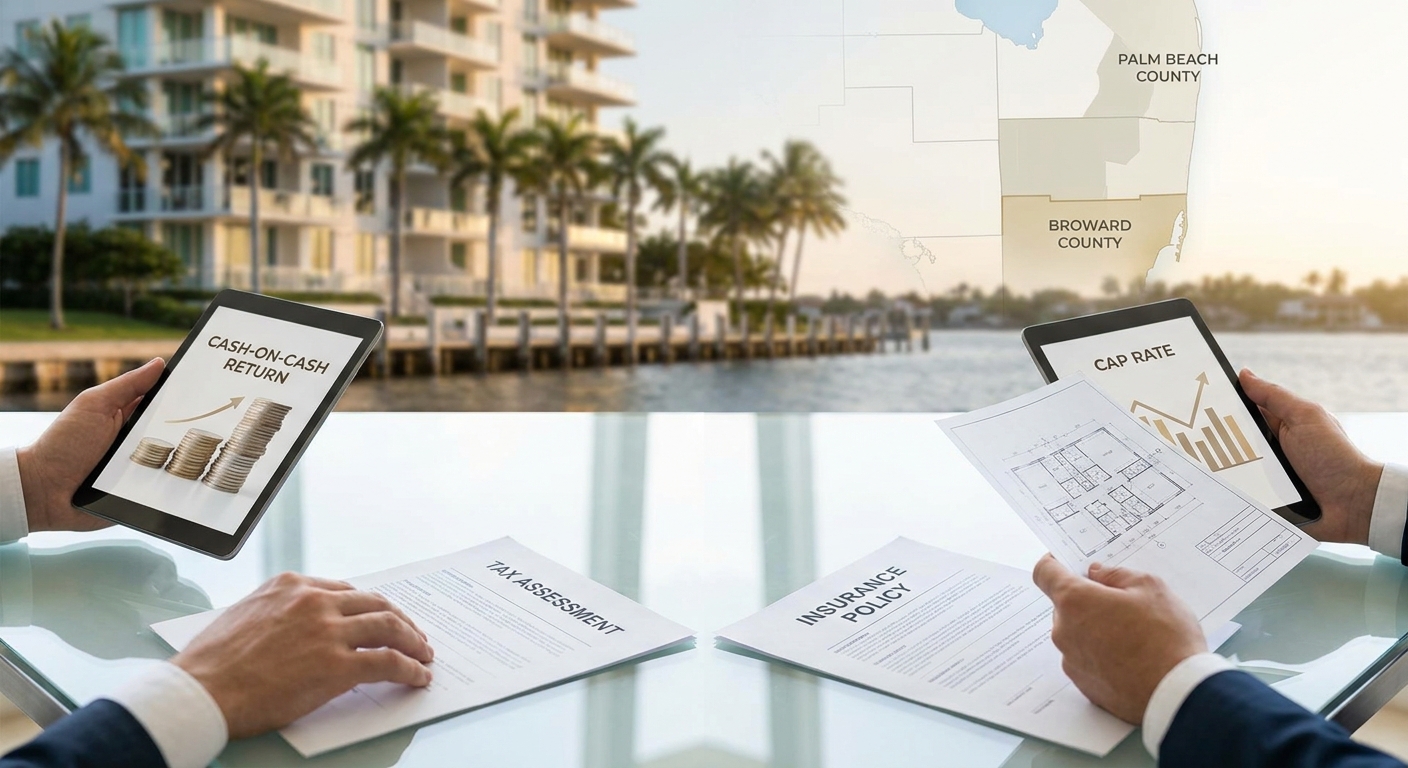
When evaluating residential real estate opportunities in South Florida, capital allocators often confuse capitalization rate (cap rate) with cash-on-cash return. While both metrics assess profitability, they evaluate completely different aspects of an investment.
Evaluating deals in Broward County and Palm Beach County requires understanding how leverage, local tax assessments, and insurance premiums impact these numbers. Relying on cap rate alone can obscure whether a property will actually generate positive monthly cash flow.
Capitalization Rate: Evaluating Property Quality Independent of Debt
The capitalization rate measures an asset's unleveraged yield. It isolates property performance by ignoring financing terms, tax structures, and buyer-specific equity.
Formula: `Cap Rate = Net Operating Income (NOI) / Purchase Price`
To calculate Net Operating Income (NOI), subtract all annual operating expenses—property taxes, property insurance, HOA fees, maintenance, property management, and vacancy loss—from gross rental income. Debt service (principal and interest) is strictly excluded from NOI.
In South Florida, cap rates allow you to compare a townhouse in Plantation against a single-family home in West Palm Beach on an equal footing. It tells you how efficient the physical asset is at generating income relative to its purchase price, regardless of whether you pay 100% cash or put 25% down.
Cash-on-Cash Return: Evaluating Equity Efficiency
While cap rate measures the asset, cash-on-cash return measures the performance of your actual deployed capital. It accounts for leverage by factoring in annual debt service and total out-of-pocket acquisition costs.
Formula: `Cash-on-Cash Return = Annual Pre-Tax Cash Flow / Total Cash Invested`
Total cash invested includes:
- Down payment
- Closing costs (lender fees, title, escrows)
- Initial capital expenditure or rehab budget
Annual pre-tax cash flow is NOI minus annual debt service. Because financing costs vary based on interest rates and loan terms, two investors buying the exact same South Florida property at the exact same cap rate can experience drastically different cash-on-cash returns.
South Florida Underwriting Example: $500,000 Property
To see how these two metrics diverge in Broward and Palm Beach Counties, consider an underwriting scenario for a single-family residential rental purchased for $500,000.
Income & Operating Expenses:
- Gross Rent: $3,600/month ($43,200/year)
- Vacancy Allowance (5%): $2,160
- Effective Gross Income: $41,040
- Property Taxes (reassessed post-sale): $7,500
- Property & Wind Insurance: $4,800
- Maintenance & Capital Reserves (8%): $3,456
- Property Management (8%): $3,456
- Total Operating Expenses: $19,212
Net Operating Income (NOI): $41,040 - $19,212 = $21,828
Cap Rate Calculation: $21,828 / $500,000 = 4.37% Cap Rate
Now examine how financing alters the cash-on-cash return.
Scenario A: All-Cash Purchase
- Total Cash Invested: $500,000 + $10,000 closing costs = $510,000
- Annual Debt Service: $0
- Annual Cash Flow: $21,828
- Cash-on-Cash Return: $21,828 / $510,000 = 4.28%
Scenario B: 25% Down Debt Financing (6.75% Interest Rate)
- Down Payment (25%): $125,000
- Closing Costs & Escrows: $12,000
- Total Cash Invested: $137,000
- Loan Amount: $375,000 (30-year fixed at 6.75%)
- Monthly Debt Service (P&I): $2,432 / month ($29,184 / year)
- Annual Pre-Tax Cash Flow: $21,828 (NOI) - $29,184 (Debt Service) = -$7,356
- Cash-on-Cash Return: -$7,356 / $137,000 = -5.37%
In higher interest rate environments, negative leverage turns an asset with a 4.37% unleveraged cap rate into a property that loses over $600 per month when leveraged at 75% LTV.
Why Local Market Variables Drive the Gap
In South Florida, the gap between cap rate and cash-on-cash return is amplified by two key expense items:
1. Property Taxes: In Florida, non-homestead properties undergo tax reassessment upon purchase based on the new purchase price. Underwriting using a seller's historical tax bill will artificially inflate your cap rate and crash your cash-on-cash return post-closing. 2. Insurance Premiums: Windstorm and flood coverage in Palm Beach and Broward counties represent significant line-item costs. Higher fixed insurance expenses compress NOI, meaning debt service eats a larger percentage of gross revenues.
How Investors Should Use Both Metrics
Use cap rate as a baseline tool to screen properties across submarkets, such as comparing deal flow in Fort Lauderdale against Boynton Beach. Once a property passes your initial screening cap rate threshold, run a cash-on-cash return calculation incorporating your actual loan quote, local tax reassessment estimates, and carrier insurance quotes.
At The Jamie Seneca Team, we assist investors across Broward and Palm Beach County in underwriting real market conditions, ensuring capital is deployed efficiently with realistic return expectations.